The AASA Safety and Recovery Team

Since the start of the year the Australian Auto-Sport Alliance (AASA) has deployed a dedicated Safety and Recovery Team at all its national circuit motor racing events to complement and boost existing circuit equipment and personnel, but what does the job involve and who are the people behind it?
Whether it’s the Hi-Tec Oils Super Series or the Hi-Tec Oils AASA Short Track Nationals Series - 2026 Powered by WOLF SPORTS, the crew will be on the scene quickly. The aim is to get racing back underway as quickly as possible in a safe manner, while also checking the wellbeing of the competitors.
Already this year the AASA Safety and Recovery Team has received plaudits online from 2014 Bathurst 1000 winner Paul Morris and former Sandown 500 victor Scott Pye for the speed in which they execute a recovery.

The team is led by Sports Compact category president Travis Talbot and built up of several other Sport Compact members and racers. But how did the team come together?
“I got to know AASA CEO Stephen Whyte really well, he always wanted me to have a job somewhere doing something within the AASA,” he recalled. “Just before Marcos Ambrose came on board as the AASA Competition and Commercial Director, he saw Michael Fitzgerald (Fitzy) and myself do some recoveries at the last Super Series round in 2025.
“He was impressed, and when he got the job at AASA instantly said, ‘you need to be running the recovery crew for us.’
“The Sports Compact crew have all done similar jobs in the past, including Linda Devlin and Lee Nuttall, who's the Vice President of Sports Compact.
“My wife Lauren Talbot races also, she's actually a senior team leader in Ambulance Victoria and is a great asset to have. As well as Fitzy, we couldn’t do it without that bloke.
“It's just about putting the right people in the right places. I feel the fact that our crew is made up of people that race cars, makes it better.
“I try to have my same group at every event. I can swap people in and out if they're not available, but they're people I know and I trust, and that's really the key.”
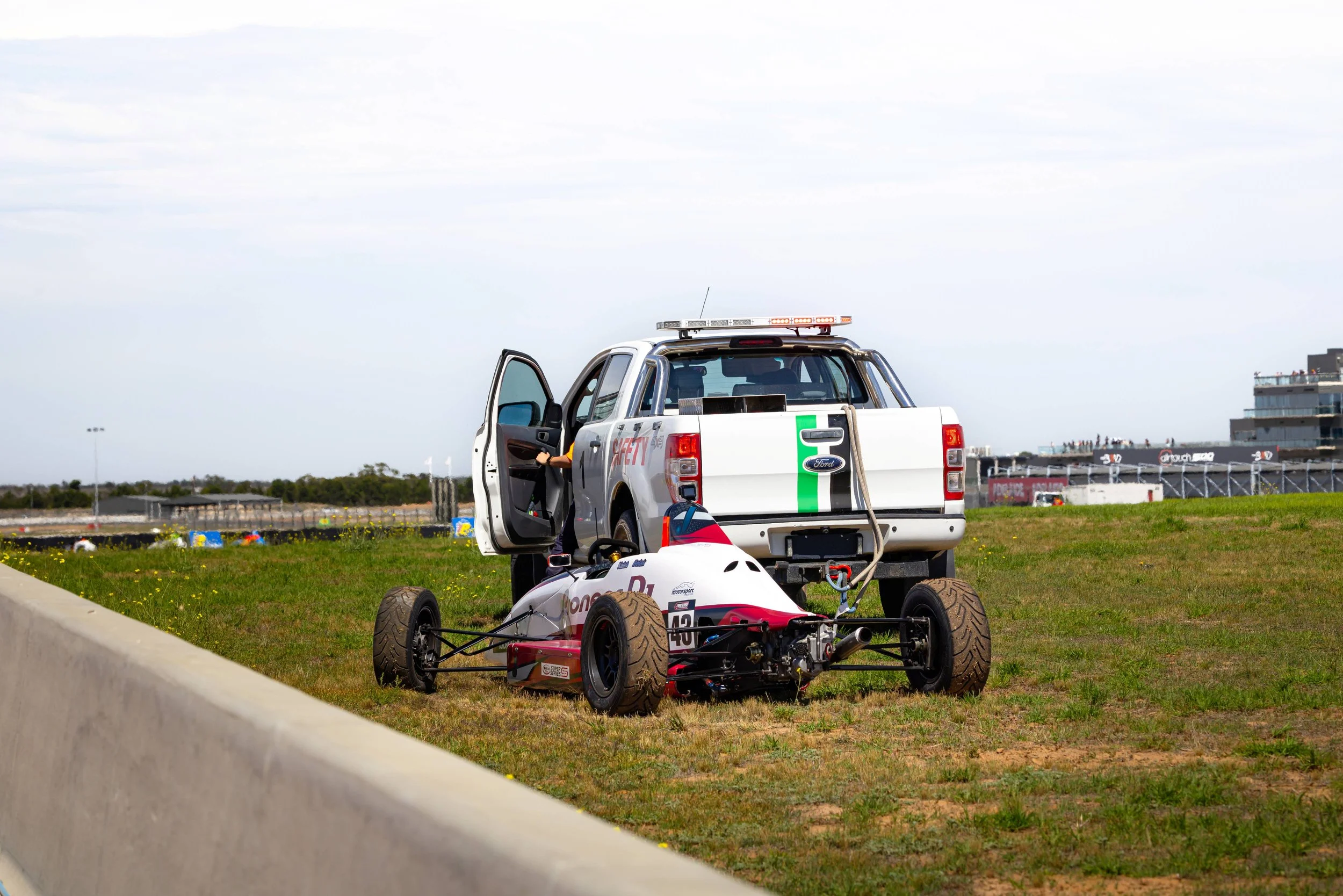
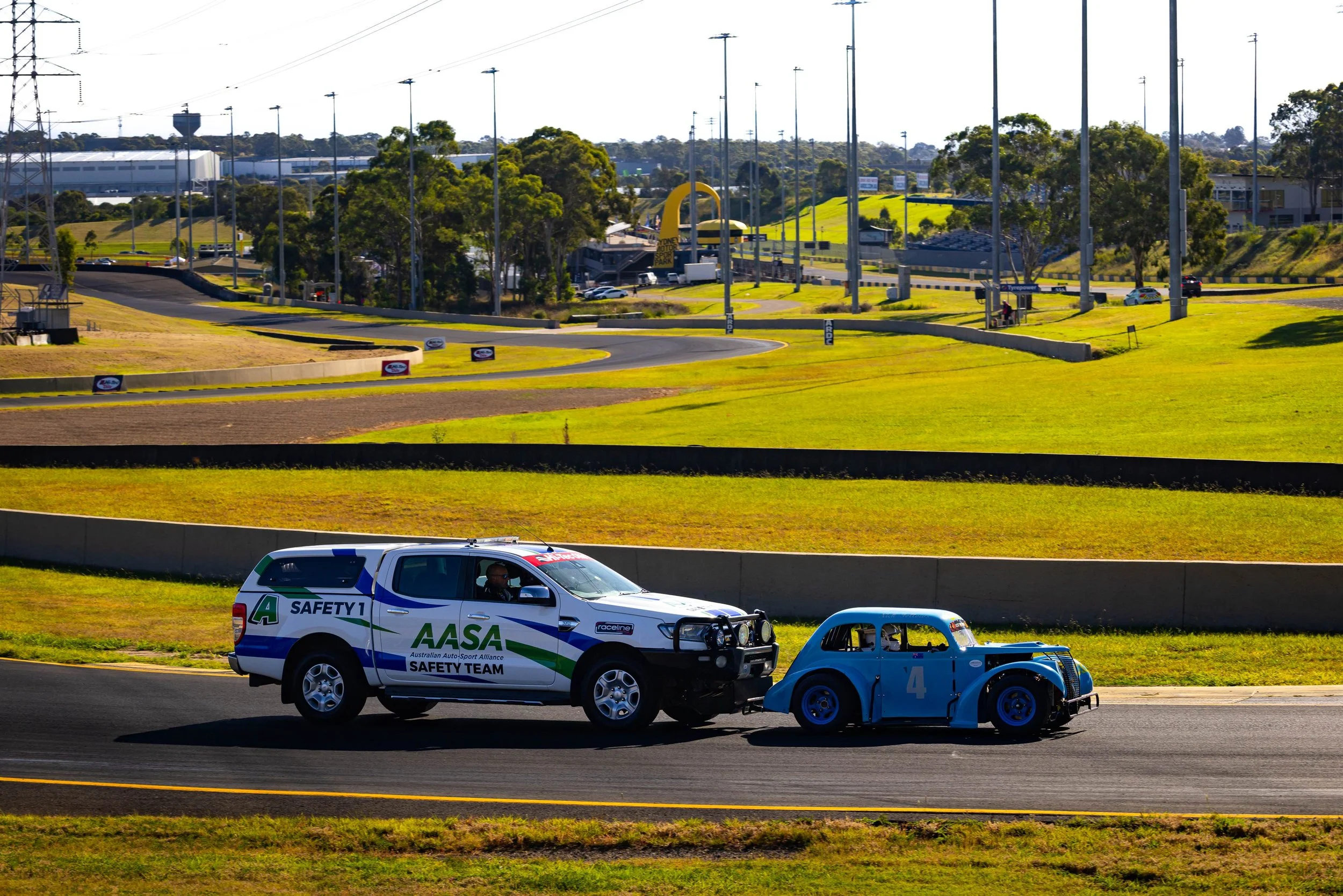
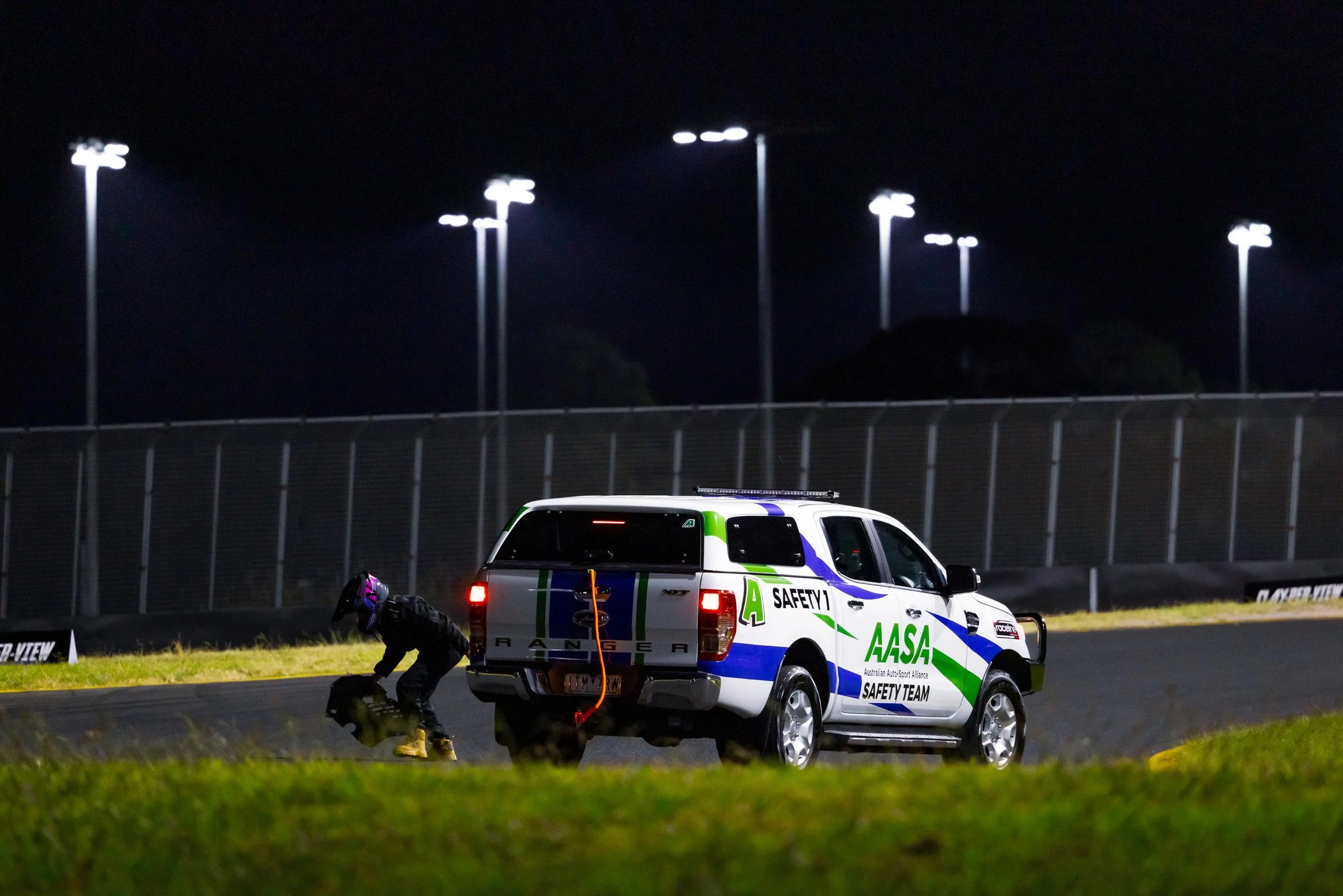
The team is made up of half a dozen members, two people in each of the utes and a further two in the truck with the tilt tray on the back.
Talbot likes consistency, keeping each member of the team in the same role, a position which benefits that person’s particular strengths.
“The tilt tray usually has Fitzy behind the wheel and someone else alongside him,” he explained.
“Generally, in Safety 1 I have someone who's medically trained, so they can make that quick initial judgment upon arriving at the scene of an accident, does the ambulance need to be called onto the track.
“They can assess the situation, not particularly to treat, just to manage that side of a situation, the position is usually filled by my wife.
“Safety 2 is just a good crew of people that can follow instruction, that’s vital especially on a televised race weekend, it is so important that the racing and things happen when they're meant to happen.”
The crew have three options to recover a racing car, tow the vehicle, put it onto the tilt tray, or a new third option, push it off the circuit.
Talbot explained that this decision is often made on the way to an accident. This is based on the most efficient way to recover the vehicle and what is going to cause the least amount of damage to the racing car.
“If it's a simple car in a sand trap, obviously you're not going to push that one, so that's a job for the strap, we just simply tug it out. Get it back in the race, to the pits, or somewhere safe.
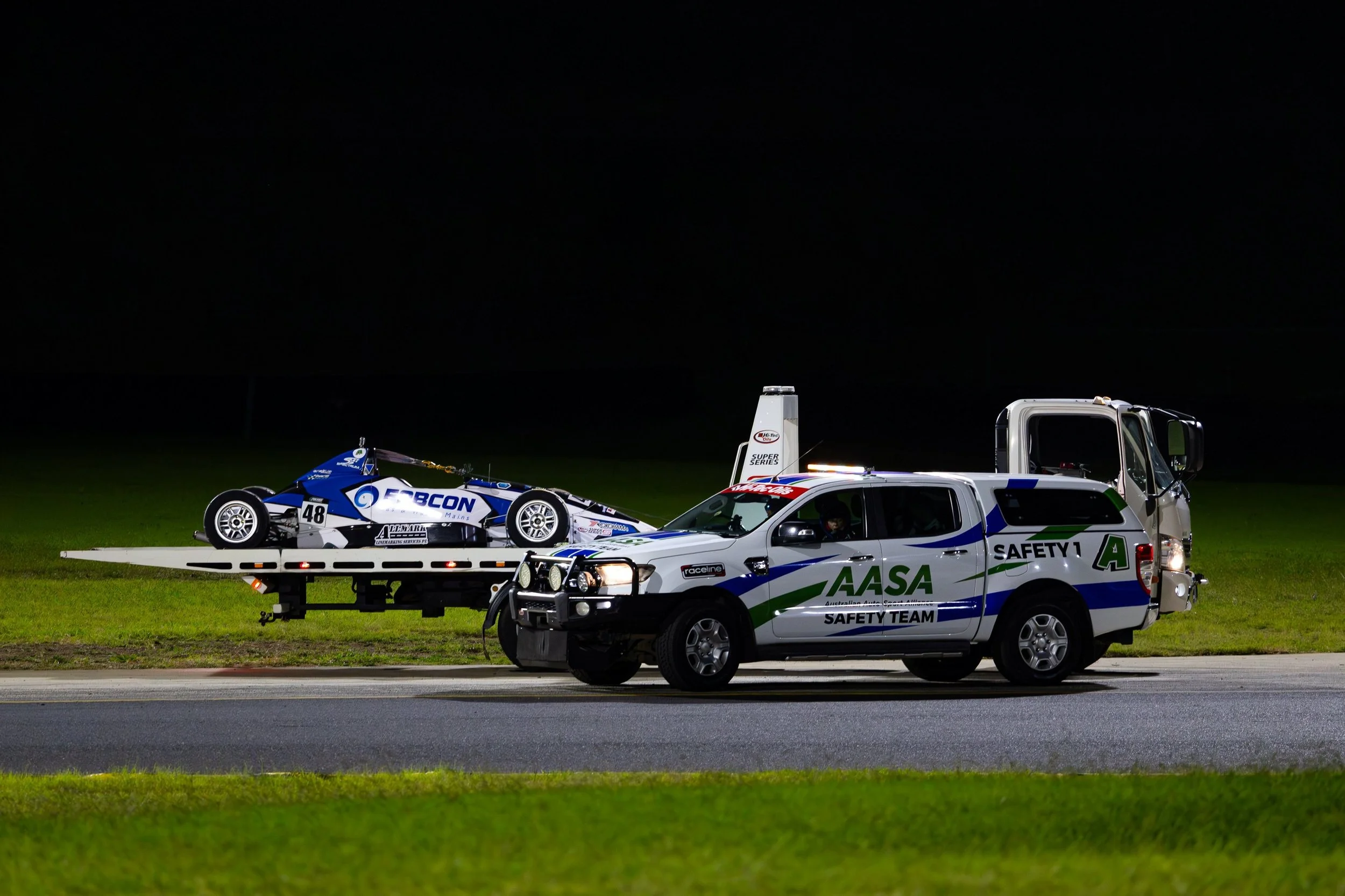
“The tilt tray is called into action if there's cars with wheels hanging off left, right, and centre, or if someone's caught fire. You're not going to be able to tow that along the track, because that’ll deposit debris.
“The push bar we use to quickly move a car stopped on the infield.
“The push bar was Marcos Ambrose's idea, something they use in the United States.
“I actually designed the one used by the AASA and looked at many different options. The City Link here in Melbourne are actually pushing cars out of the tunnels with a recovery vehicle.
“I looked at that and thought, well, it's got to be able to be taken on and off, so we can travel between events on the road, and that's how I came up with what we've got, and it generally works pretty damn good.
“On the race track it really is case by case, not one recovery has been the same as another since taking on the role.”
The great team however needs great equipment, and they have just that. A couple of 4WD utes and a truck.
“The utes are your run-of-the-mill, four-wheel-drive Ford Rangers, with its four-wheel-drive low gearing it can easily tow a car that's damaged out of the situation,” he said.
“The tilt tray we use is a Hino split back tilt slide truck, which really helps to get those low race cars onto the truck without further damaging them.”
Two factors essential to a successful weekend for the recovery team are situational awareness and safety of all involved, both for the competitors on track, but also for the team off it.
“For me the weekend always starts with circuit familiarisation,” Talbot said. “That's the most important thing. Knowing where your hidey holes are, where you put a car to keep a race going, where you can push a car to get it back to the pits without going on to the circuit.
“Facilities, like Winton and The Bend, they have excellent infield areas where you can just get them to the infield, you can then use a tilt tray to get them back to their pits without disrupting the racing.
“Circuits with the pits on the infield like Sydney Motorsport Park are a little more difficult. But there are infield roads that you can push cars into and get them back to the pits so the racing team can fix their car for the next race.”
“The other most important thing is making sure everyone is safe, both the drivers, and my crew.
“You will often see the second recovery car covering the accident while the other crew is performing the clean-up operation. That's all about crew safety because at the end of the day, if you've got a track that's under yellows and the Pace Car is rolling around, we are going to cover our men and women, that's the way we're going to do it.”
Talbot and his team have been taken back by the positive feedback from competitors and race fans at the job they are doing, and have been shocked that so many people have noticed their efforts.
“People are talking about what we're doing, Marcos, Steve, and myself, we’re really pushing quickness and getting back to green,” he said. “The people that are out on the track and people watching TV, they're our customers, everything's about giving them the best product we can.
“I don't really think we are doing anything special; we are just doing the job that should be done. It's a pinch yourself moment to see comments from the stars of the sport, but to know what you're doing in motorsport is making a difference to every competitor, that's the biggest thing.”